Ph.D. in Network Learning Technology
National Central University, Taiwan
September 2011 – November 2018
Assistant Professor, Department of English
National Taichung University of Education
How can AI help students think and write without doing the thinking for them? I study how AI-generated questions and peer discussion help English learners develop, defend, and revise their own ideas.
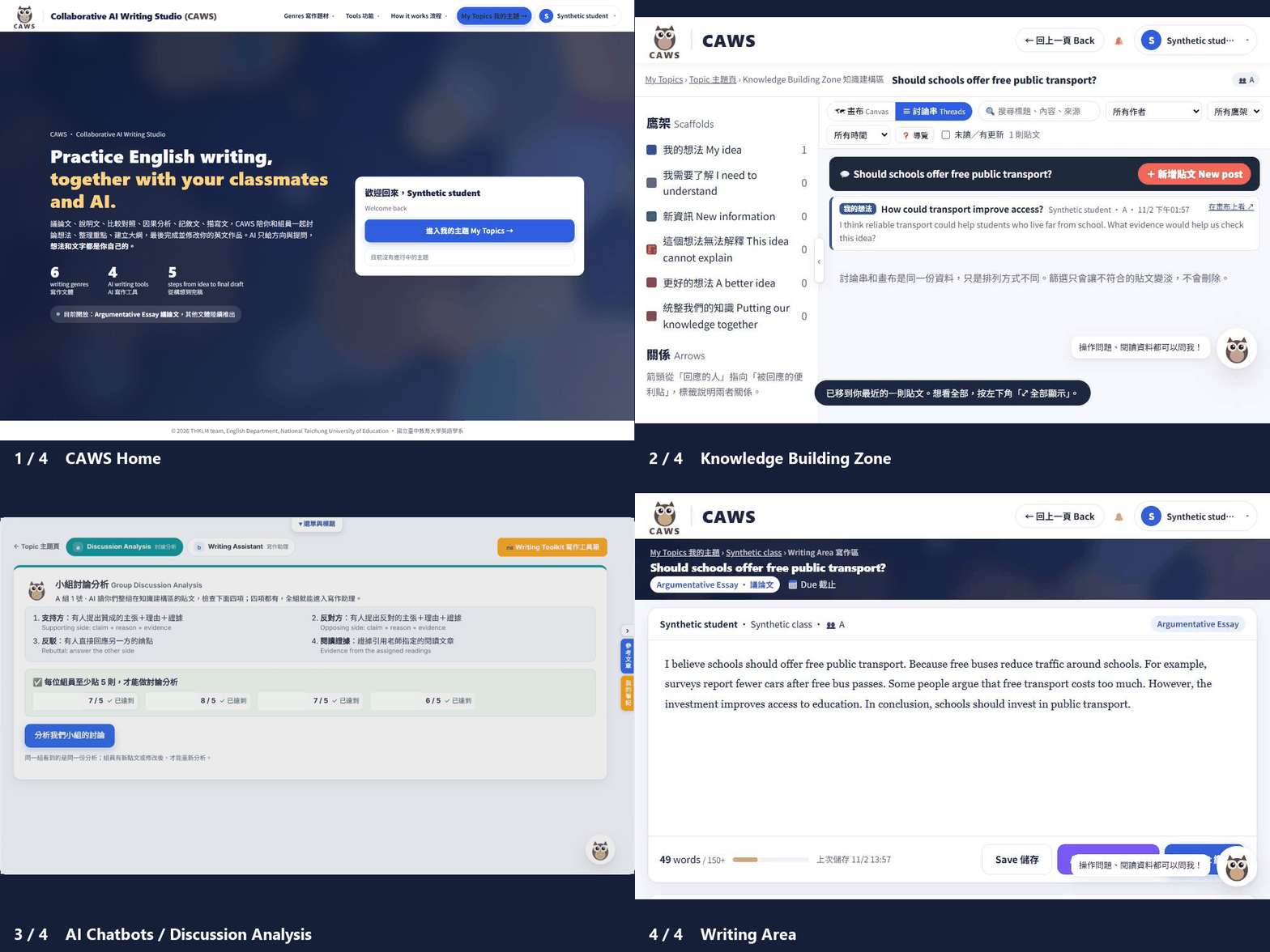
Collaborative AI Writing Studio
Explore the student workspace ↓
Under maintenance · 維護中CAWS helps students turn group discussion into an English essay of their own.
Related research on collaborative AI and argumentative writing ↗
Open CAWS ↗ · Under maintenance
About
I am an educational technology and language-learning researcher whose academic background brings together English language teaching and learning technology. This interdisciplinary training has shaped my work at the intersection of artificial intelligence, computer-assisted language learning, argumentative writing, and collaborative knowledge building.
National Central University, Taiwan
September 2011 – November 2018
University of Stirling, United Kingdom
September 2006 – November 2007
My teaching career spans secondary and higher education, giving me more than twenty years of experience with learners at different stages of English development. Before moving fully into higher education, I taught English in junior and senior high schools, where I also worked in curriculum leadership and with gifted English learners. These experiences continue to shape the questions I ask as a researcher: how can technology increase opportunities for meaningful language use, support dialogue and revision, and help learners develop stronger ideas without doing the thinking for them?
My current work examines question-only AI Socratic dialogue, AI-supported writing environments, human–AI co-creative learning, and learning analytics. Across these projects, I am particularly interested in designing technologies that support productive language use, make learning processes visible, and preserve learner agency and authorship.
Research
How can AI guide English learners through a writing task by asking questions?
Read the Socratic AI studyHow do students use evidence, respond to counterarguments, and stay engaged when they write together?
See the writing engagement scaleHow can online tools help students build on and improve each other’s ideas?
Read the knowledge-building study abstractWhat do students’ interactions with AI reveal about how they evaluate and revise its suggestions?
See the AI literacy conference poster entryPublications
Journal of Second Language Writing · DOI ↗
International Journal of Computer-Supported Collaborative Learning · DOI ↗
Assessing Writing · DOI ↗
Projects
進行中的計畫優先列出,各組依起始日期由新到舊
This project develops a Knowledge Building model for science inquiry and examines collaborative argumentation and learning transfer with generative AI support.
國科會研究計畫(整合型) · 計畫主持人 · 3 年期 · NSTC 115-2410-H-142-036-MY3
2026.08.01–2029.07.31
This project promotes the use of generative AI learning handbooks in primary and secondary schools and supports their practical application.
教育部委辦計畫 · 協同主持人 · 5 個月
2026.08.01–2026.12.31
This project develops a handbook on using generative AI for learning in primary and secondary schools.
教育部委辦計畫 · 計畫主持人 · 6 個月
2026.02.01–2026.07.31
This project integrates an AI writing assistant and a collaborative Knowledge Building platform into English argumentative writing instruction.
教育部教學實踐研究計畫 · 計畫主持人 · 1 年期
2025.08.01–2026.07.31
This project develops and trials adaptive earth science teaching materials for junior and senior high schools.
教育部委辦計畫 · 計畫主持人 · 1 年期
2025.01.01–2025.12.31
This project develops and trials adaptive science teaching materials for primary and junior high schools.
教育部委辦計畫 · 計畫主持人 · 1 年期
2025.01.01–2025.12.31
This project develops and evaluates an online platform for collaborative argumentation and essay writing on the UN Sustainable Development Goals.
國科會研究計畫 · 計畫主持人 · 2 年期 · NSTC 113-2410-H-008-078-MY2
2024.08.01–2026.07.31
This project develops improved digital science learning materials for primary and junior high schools.
教育部委辦計畫 · 計畫主持人 · 1 年期
2024.01.01–2024.12.31
This project uses a collaborative Knowledge Building platform to redesign how students learn to write argumentative essays in English.
教育部教學實踐研究計畫 · 計畫主持人 · 1 年期
2023.08.01–2024.07.31
This study examines how collaborative argumentation grounded in Knowledge Building affects university students’ informal reasoning and essay writing on socioscientific issues.
國科會研究計畫 · 計畫主持人 · 1 年期 · NSTC 111-2410-H-A49-024
2022.08.01–2023.07.31
Teaching
My teaching brings together language education, digital pedagogy, and research training for students and graduate learners.
Research design, measurement, statistical analysis, and academic reporting for graduate students.
Developing claims, evidence, rebuttals, revision, and responsible use of AI support.
Digital tools, learning environments, and technology-mediated language pedagogy.
Human–AI interaction, learning design, AI literacy, and preserving learner agency.
Contact
For research collaboration, academic exchange, or invited talks, please get in touch by email.
Taichung, Taiwan